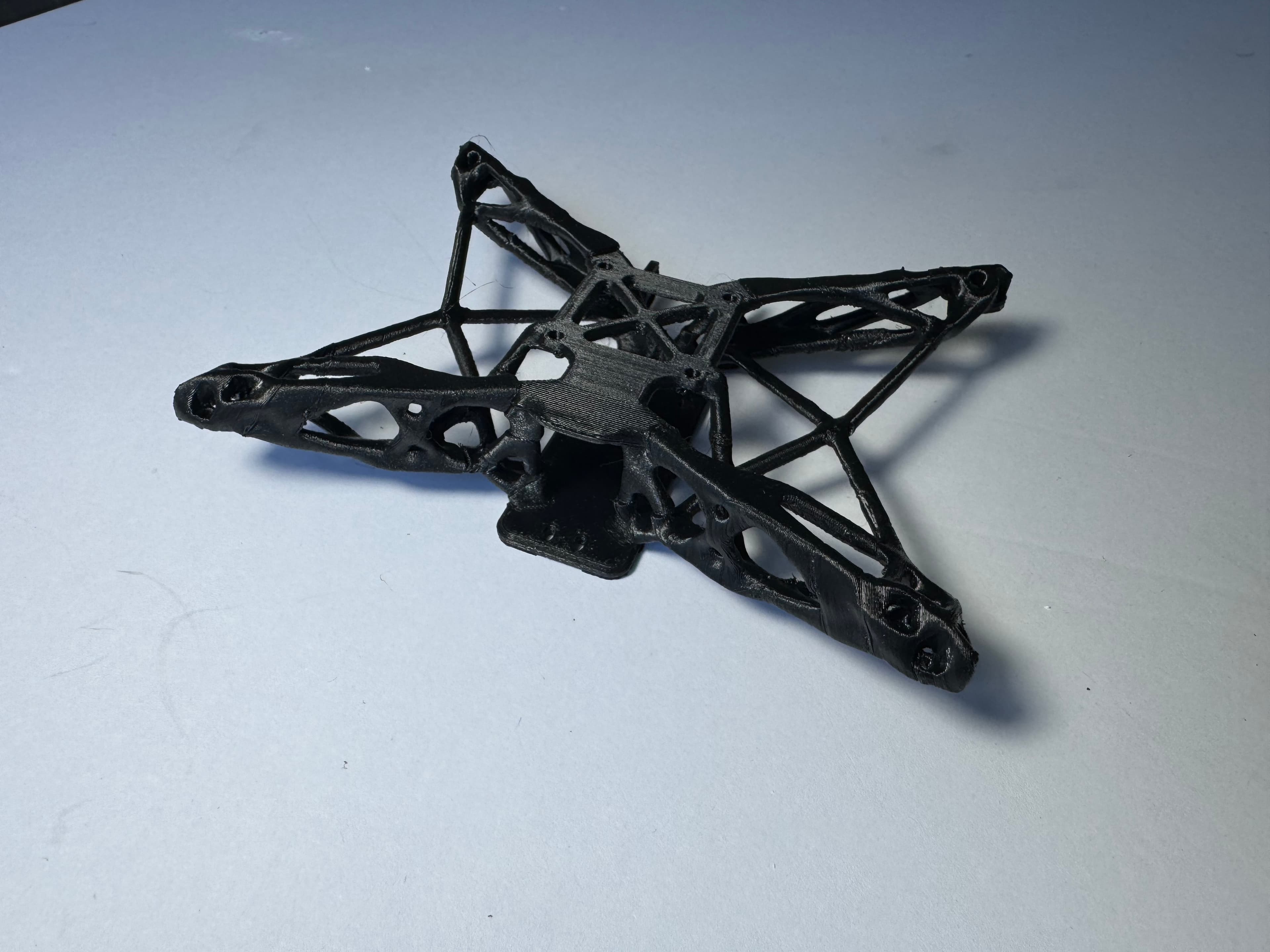
How to make 3D prints stronger
Orient the part so the load runs along the layers, then add walls. Both matter more than infill. FDM parts are weakest between layers, so most strength problems are orientation or layer-adhesion problems.
Strongest print orientation
Layer bonds are weaker than the plastic, so a hook printed standing up snaps at a layer line, while the same hook printed flat bends first. Rotate the part so the main load runs along the layers before changing any setting.
Walls before infill
Bending and torsion are carried by the outside of a part. Going from two walls to four usually adds more strength per gram than doubling infill. For functional parts, use four to six walls and extra top and bottom layers.
Strongest infill patterns
Gyroid and cubic are strong in every direction, the safe choice for unknown loads. Grid or rectilinear can be stronger along one known direction. Lightning only supports top surfaces. Past about 40% infill, add walls instead.
Improving layer adhesion
Layers bond when new plastic is hot enough to melt into the layer below. Print toward the top of the filament's range, cut part cooling for PETG, ABS, ASA and nylon, and enclose the printer for high-temperature materials. Stay under your hotend's max volumetric speed, since under-melted plastic bonds poorly, and dry hygroscopic filament.
Changing the toolpath
Settings only rearrange flat layers. Unlayered Slicer's non-planar slicing curves layers along the load path on a 3-axis printer, within your toolhead's clearance, and it includes tools aimed at part strength. On a 5-axis printer, layers can follow the load path through the whole part.